
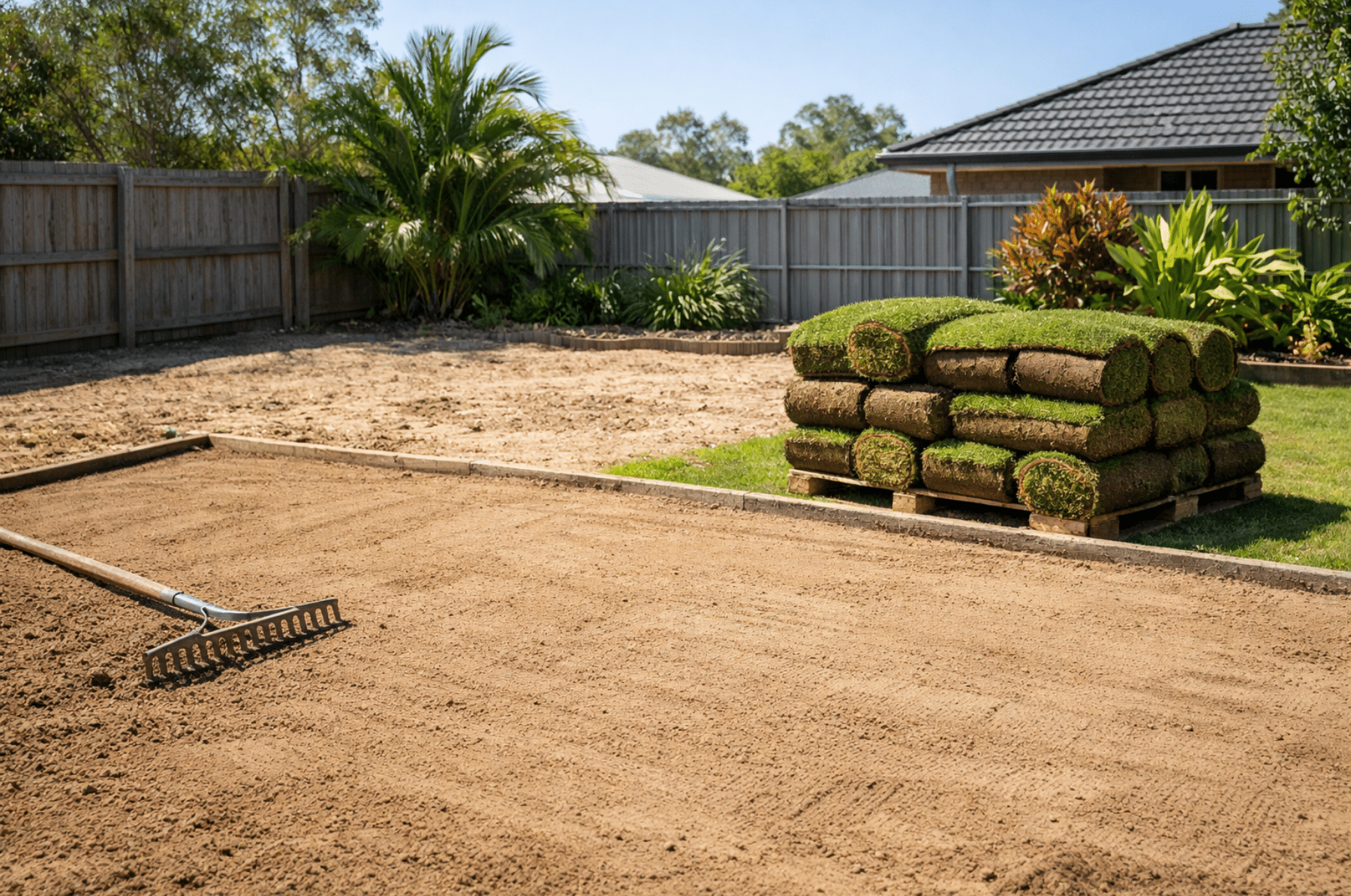
Laying new turf feels exciting. Fresh rolls, instant green, weekend transformation complete.
But here is the truth most people learn the hard way. If the base underneath is wrong, that beautiful lawn can struggle within months.
In Caboolture and across South East Queensland, lawn success is not just about choosing good turf. It is about what goes under it.
If you want a lawn that drains properly, handles heavy rain, survives summer heat, and actually lasts, it all starts with the right soil preparation.
Why Most New Lawns Fail in Caboolture (It’s Not the Turf’s Fault)
When lawns fail, turf often gets blamed.
Yellowing patches. Soft soggy areas. Hard dry sections that will not absorb water. Roots that never establish properly.
In most cases, the problem is not the turf variety. It is the ground underneath.
Caboolture soils can be sandy in some areas and heavy clay in others. Both create challenges. Sand drains too fast and struggles to hold nutrients. Clay holds too much water and suffocates roots.
Without proper turf underlay and preparation, even premium turf cannot perform.
What Is Turf Underlay And Why It Matters More Than You Think
Turf underlay is the specially blended soil layer that sits directly beneath your new turf.
It is not just dirt. A quality turf underlay is designed to:
- Improve drainage
- Provide nutrients for root establishment
- Create a stable, level base
- Encourage deep root growth
- Reduce long-term lawn stress
Think of it as the foundation of your house. If the foundation is poor, the structure above it will always have problems.
At Landscape City, we supply turf underlay blends suited to SEQ conditions so your lawn has the best possible start.
The Ideal Turf Underlay Mix for SEQ Conditions
In South East Queensland, the ideal turf underlay needs balance.
Too sandy and water runs straight through. Too heavy and roots sit in water after summer storms.
A strong underlay mix typically includes:
- Screened sandy loam for structure and drainage
- Organic matter to improve moisture retention
- Soil conditioners to support early root development
This combination allows water to move through the soil without waterlogging while still holding enough moisture to support growth in hot conditions.
Getting this balance right is what separates a lawn that survives from one that thrives.
Drainage First: If Water Can’t Escape, Your Lawn Won’t Survive
Caboolture summers bring intense rain events. If water cannot escape through the base layer, turf roots will rot.
Poor drainage leads to:
- Fungal disease
- Patchy growth
- Soft, boggy areas
- Turf lifting or separation
Before laying turf, always check your drainage. If the area pools water after rain, you may need to improve the sub-base with drainage gravel or adjust the soil profile.
A well-prepared base should allow water to drain freely while still retaining enough moisture between watering cycles.
How Much Underlay Do You Actually Need? (Avoid Costly Guesswork)
One of the biggest mistakes homeowners make is under-ordering soil.
For new turf preparation, you generally want 75mm to 100mm of turf underlay across the entire area.
To work out how much you need:
- Measure the length and width of your lawn area
- Multiply to get square metres
- Multiply by your desired depth in metres
For example, a 100m² lawn at 100mm depth requires around 10 cubic metres of underlay.
Not sure what that looks like? If you have a 6×4 trailer:
- 1 box trailer equals 0.666 cubic metres
- 2 box trailers equals 1.333 cubic metres
- 3 box trailers equals 2 cubic metres
- 4 box trailers equals 2.333 cubic metres
For larger jobs, a 10m³ load with free delivery across Caboolture often works out far more cost-effective than multiple small trips.
Our team can help you calculate quantities properly so you do not waste money or fall short halfway through.
Topsoil vs Turf Underlay: Why They’re Not the Same Thing
This is a common confusion.
Topsoil is a general-purpose soil product. It can be useful for garden beds, leveling, or filling low spots.
Turf underlay is specifically blended for lawns.
The difference is in structure, drainage capability, and nutrient balance. Using basic topsoil under turf can lead to compaction, poor drainage, and shallow root systems.
If you want long-term performance, turf underlay is the better choice.
Step-by-Step: What to Put Under Turf for Strong Root Growth
Here is a simple checklist to prepare your base properly:
- Remove old grass, weeds, and debris
- Level the area and address any drainage issues
- Install drainage gravel if needed in problem zones
- Spread 75mm to 100mm of quality turf underlay
- Level and lightly compact the surface
- Water the base lightly before laying turf
- Lay turf immediately and water thoroughly
Following these steps gives roots the environment they need to grow down, not just sideways.
Strong roots mean better drought tolerance, fewer disease problems, and a lawn that stays greener longer.
Get Your Base Right the First Time (Free 10m³ Delivery in Caboolture)
At Landscape City, we supply quality turf underlay, screened soils, drainage materials, sands, and everything you need to prepare your lawn properly.
Whether you are a DIY homeowner, a landscaper, or a tradie working on a larger project, we make it simple to get the right quantities without guesswork.
We offer free delivery on 10m³ loads across Caboolture, Elimbah, Morayfield, Burpengary, Beerburrum, Woodford, Bribie, Narangba, and Deception Bay.
If you are investing in new turf, do not cut corners underneath it.
Call Nick and the team today for mates rates and practical advice from locals who understand SEQ soil conditions.
Get the base right once, and enjoy a lawn that actually lasts.

Leave a Comments