
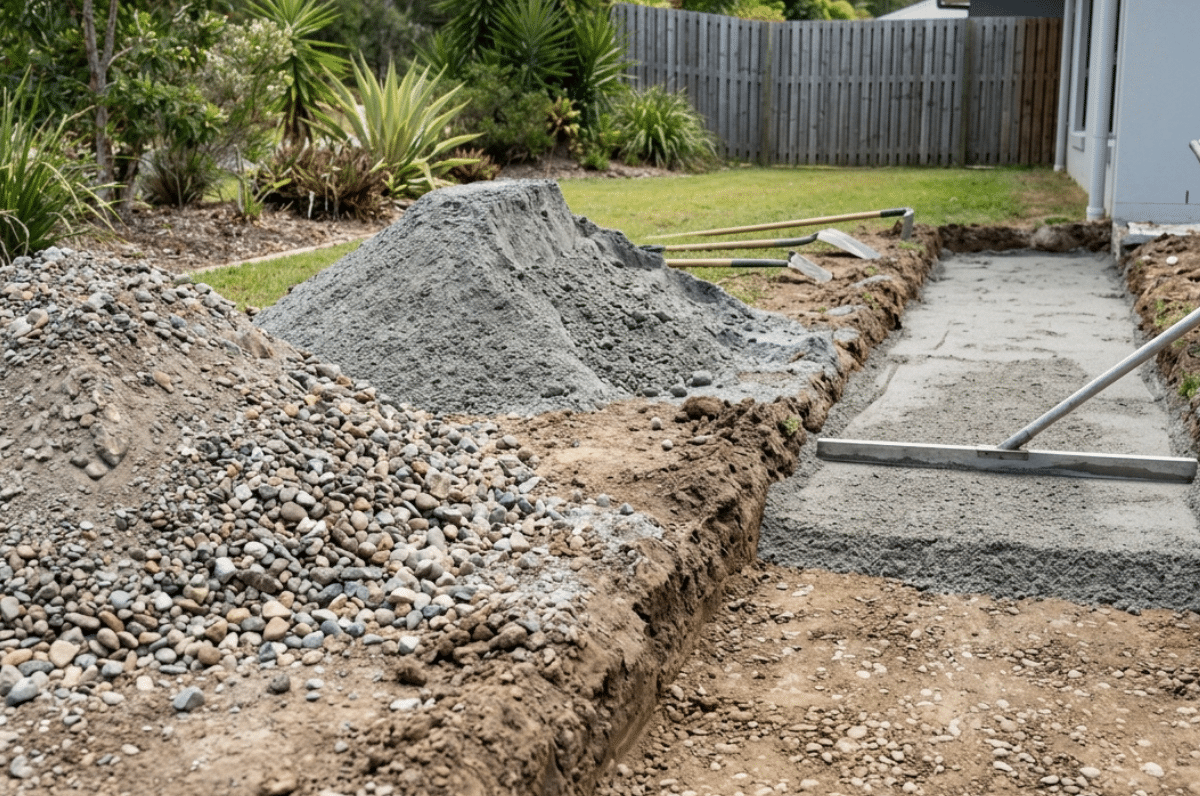
Laying a new driveway, pouring a shed slab or putting down pavers out the back? Then you’ve probably come across two names over and over: road base and crusher dust.
They’re both crushed rock products. They both compact, and they’re often sold side by side. But they do very different jobs. Use the wrong one and you could end up with sinking pavers, a rutted driveway or a slab that cracks before its time.
This guide breaks down road base vs crusher dust in plain terms. We’ll cover:
- What each product is for
- Where bedding sand fits in
- How to build a solid base
- How much to order from Landscape City in Caboolture
What Is Road Base and What Is It Used For?
Road base is a blend of crushed rock in a range of sizes. It runs from stones around 20mm down to fine particles. That mix of coarse and fine material is what makes it so useful.
When road base is dampened and compacted, the fines fill the gaps between the larger stones. The result is a dense, hard-wearing layer that locks together and spreads loads evenly. It’s the same principle used under real roads, which is where the name comes from.
Common uses for road base:
- Sub-base for driveways and car parking areas
- Base layer under pavers, paths and patios
- Preparation under shed slabs, house slabs and concrete paths
- Building up and levelling low areas before construction
- Hardstand areas for caravans, boats and trailers
- Unsealed rural driveways and access tracks
In short, road base is your structural layer. It does the heavy lifting.
What Is Crusher Dust and What Is It Used For?
Crusher dust is the fine material left over when rock is crushed. It’s usually 5mm and under, and it has a texture somewhere between coarse sand and grit.
Because the particles are small and angular, crusher dust compacts firmly and is easy to screed smooth. That makes it great for fine levelling, though it doesn’t have the load-bearing strength of road base.
Common uses for crusher dust:
- A thin levelling layer over compacted road base
- Bedding for pipes and conduits in trenches
- Levelling under water tanks, garden sheds and cubby houses
- Filling gaps and voids during construction
- Paver bedding in some applications (more on this below)
Think of crusher dust as your finishing and levelling layer, not your foundation.
Road Base vs Crusher Dust: Key Differences at a Glance
| Feature | Road Base | Crusher Dust |
|---|---|---|
| Particle size | Mixed, about 20mm down to fines | Fine, about 5mm and under |
| Main role | Structural base and load-bearing | Levelling, bedding and filling |
| Compaction | Very high when moist and compacted | Firm, but less load-bearing |
| Typical depth | 75 to 150mm compacted | 20 to 50mm |
| Drainage | Moderate | Can hold moisture |
| Best for | Driveways, slab prep, hardstands | Levelling, pipe bedding, under tanks |
The simple rule: road base goes down first and does the work. Crusher dust goes on top when you need a smooth, fine finish.
Which Is Better for Driveways, Shed Slabs and Pathways?
The right choice depends on the job, so here’s how it plays out across the most common projects.
Driveways
Road base is the clear winner. A driveway has to handle the weight of cars, trailers and the odd delivery truck. You need a compacted road base layer of around 100 to 150mm, laid over firm, well-prepared ground.
On top of that, you can finish with:
- Concrete
- Pavers on a bedding layer
- Decorative gravel for a natural look
Crusher dust alone won’t handle vehicle traffic. It tends to rut and wash out over time.
Shed slabs
Under a concrete shed slab, compacted road base gives you a stable foundation that won’t shift. Around 75 to 100mm is typical for a standard backyard shed, but always follow your slab design or engineer’s specs.
When you pour the slab itself, a concrete blend mixed with builders cement gives you the strength you need. You can grab both from the same yard.
For a small kit shed sitting on pavers or a timber frame, a levelled bed of crusher dust is often enough.
Pathways
For a garden path that only sees foot traffic, a thinner road base layer of 50 to 75mm compacted works well. Finish it with pavers, decorative gravel or a compacted crusher dust surface.
A compacted crusher dust path has a tidy, natural look. It suits low-traffic areas, but expect some maintenance after heavy rain.
Crusher Dust vs Bedding Sand: What Should Go Under Your Pavers?
This is one of the most debated questions in DIY paving. Both crusher dust and bedding sand are used under pavers around South East Queensland, and each has its fans.
Bedding sand
- Clean, consistent sand designed for paving
- Screeds evenly and lets pavers bed in when compacted
- Drains freely, so water doesn’t sit under the pavers
- Recommended by many paver manufacturers
Crusher dust
- Compacts very firmly and can feel more solid underfoot
- Holds more moisture than sand
- Can set hard, which makes lifting and re-laying pavers harder later on
Our advice: for most residential paving, bedding sand is the safer, more forgiving choice. This is especially true with Caboolture’s heavy summer storms, where good drainage matters. Always check your paver manufacturer’s installation guide, as some specify which bedding material to use.
Crusher dust still has a place in paving projects. It’s excellent for levelling under the road base or filling low spots before the bedding layer goes down.
How to Build a Solid Paver Base With Road Base, Crusher Dust and Bedding Sand
A long-lasting paved area is all about layers. Here’s a reliable approach for a typical backyard patio or path.
- Excavate. Dig out the area to allow for your road base, bedding layer and paver thickness. Remove grass, roots and soft topsoil. Keep any good garden soil for your beds.
- Set your falls. Plan a slight slope away from the house, about 1 in 100, so water runs off instead of pooling.
- Compact the subgrade. Run a plate compactor over the exposed ground to firm it up.
- Lay the road base. Spread it in layers (called “lifts”) of about 50 to 75mm. Dampen each lift and compact it before adding the next. Aim for 75 to 100mm compacted for a patio.
- Level low spots. Use a little crusher dust to fill any hollows in the compacted road base if needed.
- Screed the bedding sand. Spread 20 to 30mm of bedding sand and screed it flat using rails and a straight edge. Don’t walk on it once it’s screeded.
- Lay the pavers. Work from a fixed edge and keep joints consistent.
- Lock it in. Install edge restraints, compact the pavers, then sweep jointing sand into the gaps.
If you’re building retaining walls nearby, put drainage gravels behind the wall. They keep water pressure off the wall and away from your new paving.
How Much Road Base or Crusher Dust Do You Need?
Use the same formula as any landscaping material:
Length (m) × Width (m) × Depth (m) = Cubic metres
The key difference with road base and crusher dust is compaction. Loose material shrinks when compacted, so you’ll need more than your finished depth suggests.
- Road base: add around 20 to 30% for compaction
- Crusher dust: add around 15 to 20%
- Bedding sand: add around 10%
Example 1: Driveway
A driveway 3m wide and 10m long needs 100mm of compacted road base.
- 3 × 10 × 0.1 = 3 m³
- Add 25% for compaction = about 3.75 m³
Example 2: Paver patio
A 4m × 5m patio needs 100mm of road base and 30mm of bedding sand.
- Road base: 4 × 5 × 0.1 = 2 m³, plus 25% = 2.5 m³
- Bedding sand: 4 × 5 × 0.03 = 0.6 m³, plus 10% = about 0.66 m³
Collecting with a 6×4 trailer?
A level 6×4 box trailer holds about 0.66 m³. But road base and crusher dust are heavy, at roughly 1.5 tonnes or more per cubic metre. Most 6×4 trailers can’t legally or safely carry a full level load of these materials. Check the compliance plate on your trailer, and plan for extra trips or delivery for bigger jobs.
Common Mistakes When Using Road Base and Crusher Dust
These are the errors we see most often. Avoid them and your project will last for years.
- Using crusher dust as a driveway base. It doesn’t have the strength for vehicle loads. Use road base.
- Laying road base dry. It needs moisture to compact properly. Dampen it, but don’t flood it.
- Compacting in one thick layer. A plate compactor only firms the top 75mm or so. Compact in lifts.
- Not ordering enough for compaction. Finished depth isn’t loose depth. Allow that 20 to 30% extra.
- Skipping the falls. Flat paving holds water, and water is the number one cause of sinking pavers.
- Building on soft ground. Remove topsoil, roots and organic matter first. Road base over spongy soil will still move.
- Overloading the trailer. Volume and weight are not the same. Heavy materials can exceed your trailer’s limit well before it looks full.
Buying Road Base, Crusher Dust and Bedding Sand in Caboolture
At Landscape City, we stock everything you need to build it right from the ground up:
- Road base, crusher dust and bedding sand
- Concrete blend and builders cement for slabs and footings
- Brickies loam for mortar work
- Drainage gravels for retaining walls
Once the hard work is done, we’ve also got garden soil, top dress for your lawn, and a full range of barks and mulches to finish off the garden.
Visit us: 32-36 Wildlily Rd, Caboolture
Opening hours:
- Monday to Friday: 6am to 5pm
- Saturday: 7am to 3pm
Pickup or delivery: We supply anything from a shovel full to a ute load, with products easy to access for loading. For bigger jobs, we can arrange delivery to your site.
Before you call, have ready:
- Your project type (driveway, slab, patio or path)
- Measurements and target depths
- Whether you’re collecting (and your trailer size) or need delivery
Conclusion
Road base and crusher dust aren’t competitors. They’re teammates, and each one has a clear role:
- Road base is your structural foundation for driveways, slabs and paved areas. Lay it moist and compact it in layers.
- Crusher dust is your levelling and filling material. It’s ideal for pipe bedding, under tanks and fixing low spots.
- Bedding sand is the safer choice directly under most pavers, thanks to its consistency and drainage.
Get the layers right, allow extra for compaction, and plan your falls. Your driveway, slab or patio will stay solid for years to come.
Not sure which product your project needs? Call Landscape City on 07 5499 0299 or drop into 32-36 Wildlily Rd, Caboolture. Tell us what you’re building, and our local team will point you to the right material in the right quantity.

Leave a Comments