
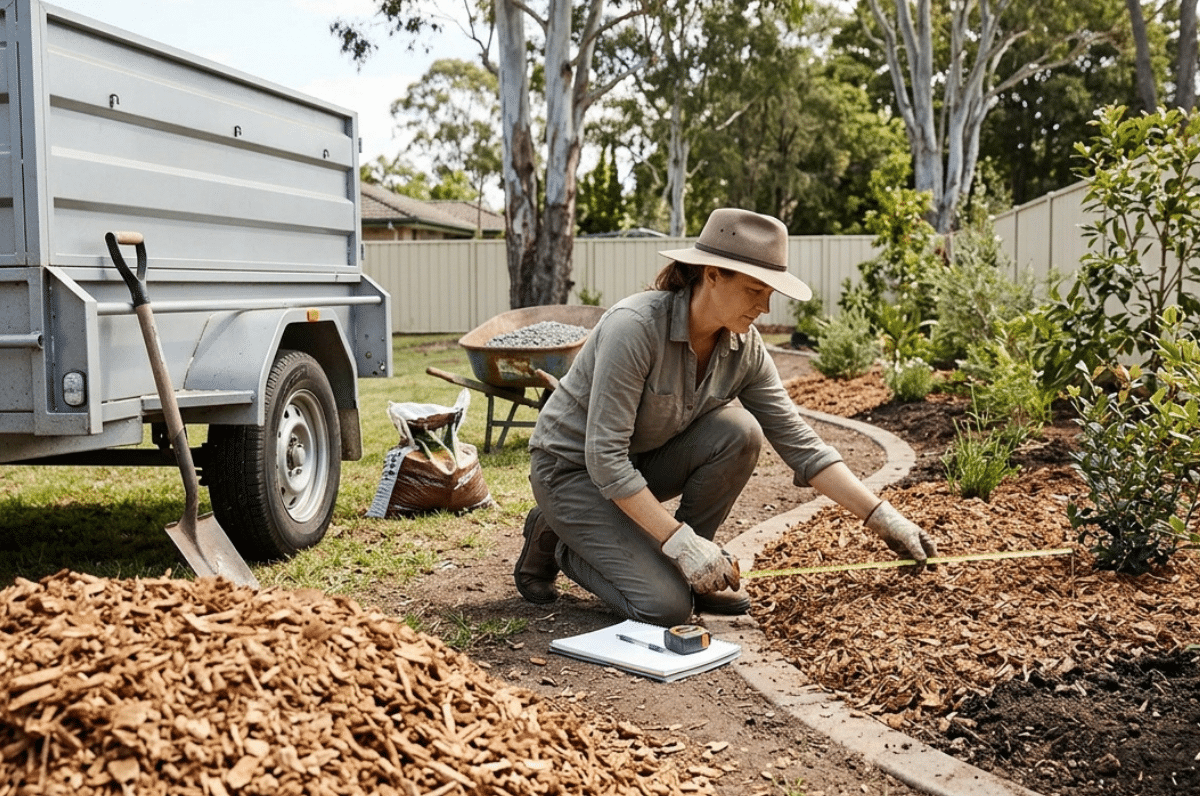
Nothing stalls a weekend garden project faster than running out of mulch halfway through a bed. Ending up with a pile of leftover soil sitting on the driveway for a month is just as frustrating.
If you’ve ever stood in the backyard wondering how much soil, mulch or gravel you need, you’re not alone. It’s one of the most common questions we hear at Landscape City in Caboolture.
The good news is that working it out is simple once you know the formula, the right depth for your project, and a few tricks for awkward shapes. This guide covers:
- The measuring method
- Recommended depths for each project type
- A quick reference table
- How many 6×4 trailer loads your order equals
- The common mistakes that catch people out
How to Work Out How Much Soil, Mulch or Gravel You Need
Landscaping supplies are sold by volume, in cubic metres (m³). To calculate volume, you need three measurements:
Length (m) × Width (m) × Depth (m) = Cubic metres
The key is to convert everything to metres before you multiply. Depth is usually thought of in millimetres, so divide by 1,000:
- 50mm = 0.05m
- 75mm = 0.075m
- 100mm = 0.1m
- 300mm = 0.3m
Example: You want to mulch a garden bed that’s 6m long and 1.5m wide, at a depth of 75mm.
6 × 1.5 × 0.075 = 0.675 m³
That’s roughly one 6×4 box trailer load. (More on trailers shortly.)
A few quick tips before you start:
- Measure with a tape, not by pacing. A “big step” can be anywhere from 70cm to a full metre.
- Write it down as you go. It’s easy to mix up length and width once you’re back at the counter.
- Sketch the area. A rough drawing with measurements helps you and our team spot anything you’ve missed.
Recommended Depths for Soil, Mulch and Gravel by Project
Depth is where most calculations go wrong. If you go too shallow, weeds push through and plants struggle. If you go too deep, you’ve paid for material you didn’t need. Use these as a starting guide.
Soils
- New garden beds: 200 to 300mm
- Veggie patches and raised beds: 300mm or more
- Turf underlay: 100 to 150mm
- Top dressing an existing lawn: 10 to 20mm
Barks and mulches
- Garden beds: 75 to 100mm
- Around trees and shrubs: 75mm, kept clear of the trunk
- Play areas and softfall zones: follow the depth specified for the equipment height, as this is a safety requirement
Decorative gravels
- Garden beds and borders: 40 to 50mm
- Pathways: 50mm over a compacted base
- Driveways: 50 to 75mm over a compacted roadbase layer
Bases, fills and drainage
- Roadbase under pavers or paths: 75 to 100mm compacted
- Roadbase for driveways: 100 to 150mm compacted
- Paving sand bedding layer: 20 to 30mm
- Drainage gravel behind retaining walls: usually a zone around 300mm wide for the full wall height
If your project doesn’t fit neatly into these categories, give the team a call. Local knowledge of our soils and weather goes a long way.
How to Measure Curved, Round or Irregular Garden Areas
Very few Caboolture backyards are perfect rectangles. Here’s how to handle the tricky shapes.
Circles (tree rings, round beds)
Area = 3.14 × radius × radius
A round bed 3m across has a radius of 1.5m, so 3.14 × 1.5 × 1.5 = 7.07 m².
Triangles (corner beds)
Area = ½ × base × height
A corner bed with 4m and 3m sides comes to ½ × 4 × 3 = 6 m².
Curved or irregular beds
You have two easy options:
- Break it into shapes. Split the area into rectangles, triangles and half-circles, work out each one, then add them together.
- Use the average width method. Measure the full length, then take width measurements every metre or so. Average those widths and multiply by the length.
Example: A curved bed is 8m long. Your width measurements are 1.2m, 1.8m, 2.0m, 1.5m and 1.0m.
- Average width = 7.5 ÷ 5 = 1.5m
- Area = 8 × 1.5 = 12 m²
Once you have the area in square metres, just multiply by your depth in metres to get cubic metres.
Quick Reference: How Many Cubic Metres for Common Garden Sizes
Once you know the area, find it in the left column and match it to your depth.
| Area | 50mm | 75mm | 100mm | 150mm | 300mm |
|---|---|---|---|---|---|
| 5 m² | 0.25 m³ | 0.38 m³ | 0.5 m³ | 0.75 m³ | 1.5 m³ |
| 10 m² | 0.5 m³ | 0.75 m³ | 1 m³ | 1.5 m³ | 3 m³ |
| 20 m² | 1 m³ | 1.5 m³ | 2 m³ | 3 m³ | 6 m³ |
| 30 m² | 1.5 m³ | 2.25 m³ | 3 m³ | 4.5 m³ | 9 m³ |
| 50 m² | 2.5 m³ | 3.75 m³ | 5 m³ | 7.5 m³ | 15 m³ |
Handy rule of thumb: 1 m³ covers about 10 m² at 100mm deep, or about 13 m² at 75mm deep. This is the most common mulch depth.
How Many 6×4 Trailer Loads Is That? Converting Cubic Metres to Trips
Plenty of locals collect their own supplies in a standard 6×4 box trailer. A level load in a 6×4 trailer holds roughly two thirds of a cubic metre (about 0.66 m³).
That works out to:
- 1 trailer ≈ 0.66 m³
- 2 trailers ≈ 1.33 m³
- 3 trailers ≈ 2 m³
- 4 trailers ≈ 2.66 m³
So 1 m³ is about one and a half trailer loads.
A very important note on weight. Volume is only half the story. Many 6×4 trailers are rated to carry well under a tonne. Heavier materials can exceed that before the trailer even looks full:
- Mulch is light. You can usually fill the trailer to the top.
- Soil is moderately heavy, especially when damp.
- Sand, gravel and roadbase are very heavy. A full cubic metre can weigh around 1.5 tonnes or more.
Always check the compliance plate on your trailer for its rated capacity. Our team will load gravel and sand to a safe level for your trailer, even if that means an extra trip.
Why Soil, Mulch and Gravel Quantities Aren’t the Same: Settling, Compaction and Weight
Two orders of the same volume don’t always behave the same way once they’re on the ground. Here’s why.
Soil settles.
Freshly delivered soil is loose and full of air pockets. After watering and a few weeks of rain, it can settle noticeably. Build new beds a little higher than your target finished level.
Mulch breaks down.
Organic mulch slowly decomposes and compacts over time. That’s good for your soil, but it means you’ll need to top it up every year or so to keep that fresh, finished look.
Bases and fills compact.
Roadbase and crusher dust are designed to be compacted with a plate compactor. Once compacted, they take up less space than when loose. If you need a 100mm compacted layer, you’ll need more than 100mm of loose material to start with.
Gravel stays put, but it’s heavy.
Decorative and drainage gravels don’t compact much. The main thing to plan for is weight, both for transport and for barrowing it around the yard.
Should You Order Extra? How Much Buffer to Allow
In most cases, yes. A small buffer saves a second trip or a second delivery fee. It also covers uneven ground and measuring errors. As a general guide:
- Mulch and soil for simple beds: add 5 to 10%
- Irregular or sloping areas: add 10 to 15%
- Roadbase and fills that will be compacted: add 15 to 25%
- Decorative gravel: add around 5%
Example: Your calculation comes to 2 m³ of roadbase for a path. With a 20% buffer, order around 2.4 m³.
Don’t go overboard, though. A little extra is handy. Several cubic metres of leftover soil on the nature strip is not. If you’re unsure, the team can help you land on the right figure.
Common Mistakes When Calculating Landscaping Supplies
These are the slip-ups we see most often, and they’re all easy to avoid.
- Forgetting to convert millimetres to metres. Multiplying by 75 instead of 0.075 gives an answer a thousand times too big.
- Guessing the depth. A bed that “looks about right” at 30mm of mulch won’t suppress weeds.
- Ignoring compaction. Ordering loose roadbase for a compacted depth leaves you short.
- Measuring the whole yard instead of the bed. Subtract paths, pavers, tanks and existing structures.
- Overloading the trailer. Volume and weight are different things. A trailer full of gravel can be well over its limit.
- Not asking for help. Our team calculates quantities every day and can often spot an error in seconds.
Picking Up or Getting Delivery of Landscaping Supplies in Caboolture
Once you’ve done the maths, getting your supplies is the easy part.
Picking up
Landscape City is at 32-36 Wildlily Rd, Caboolture. We supply everything from a shovel full to a ute load, so you only buy what you need. Products are easy to access for loading, and our team is on hand to help and give advice.
Opening hours:
- Monday to Friday: 6am to 5pm
- Saturday: 7am to 3pm
Delivery
If you’re covering a bigger area or don’t have a trailer, we can arrange delivery to your site. Turf delivery is also available, subject to order sizes, conditions and availability. It pays to get in early and lock in your order.
Before you call or visit, have ready:
- Your measurements or a rough sketch
- The project type (garden bed, path, turf, driveway)
- Your trailer size, if picking up
- Your delivery address and suburb, if you’d like it delivered
Conclusion
Working out how much soil, mulch or gravel you need comes down to four steps:
- Measure your area in metres.
- Choose the right depth for the job.
- Multiply length × width × depth.
- Add a sensible buffer for settling and compaction.
For curved beds, break the area into simple shapes. For trailer pickups, remember that weight matters as much as volume.
Get those basics right and you’ll avoid the two classic headaches of landscaping: running short mid-job, and paying for a pile you don’t need.
Ready to get started? Call Landscape City on 07 5499 0299, drop into 32-36 Wildlily Rd, Caboolture, or fill out our contact form for a quote. Bring your measurements and our friendly local team will help you get the right product in the right quantity, first time.

Leave a Comments