
New turf looks brilliant on day one. Whether it still looks brilliant six months later comes down almost entirely to what happens underneath it.
At Landscape City, we have been supplying turf, underlay, soils, sands and drainage materials to Caboolture locals for more than 40 years, and the pattern is consistent. The lawns that fail are rarely let down by the turf itself. They are let down by rushed prep, poor drainage, or a base that was never levelled properly in the first place.
This guide walks you through the full process, from killing off the old lawn to rolling and watering in the new. It is written for weekend DIYers and busy tradies alike, with practical numbers you can actually use when you order your turf supplies Caboolture side of the highway.
What Good Turf Preparation Actually Involves in South East Queensland
Turf prep is not just “spread some dirt and roll it out”. In South East Queensland we deal with heavy summer downpours, long dry stretches, clay-heavy soils in plenty of Caboolture and Morayfield estates, and intense sun for most of the year. Your prep has to account for all of it.
Good preparation covers five things:
- Removing competition. Old grass and weeds will push back through fresh turf if they are still alive.
- Correcting drainage. Water that sits will rot roots and invite fungal problems.
- Establishing levels and falls. Water should move away from the house, not toward it.
- Building a root zone. A quality underlay layer gives roots something to grow into quickly.
- Compacting and screeding. A firm, even base stops the sinking and dips that show up weeks later.
Skip any one of these and you will usually notice within the first two months. Do all five and your lawn knits down fast, handles the wet season, and copes far better through a dry January.
Allow yourself a weekend for prep on an average backyard, and order your turf for delivery once the base is ready rather than before.
Choosing the Right Turf for Caboolture Soils, Sun and Rainfall
Before you touch a shovel, work out what turf you are actually laying, because it influences how much sun and drainage the site needs.
Ask yourself three questions:
- How much direct sun does the area get? Full sun all day is very different from a narrow strip that only gets three hours between fences.
- How will it be used? Kids, dogs and cricket in the backyard call for a hard-wearing variety that repairs itself.
- How much maintenance are you up for? Some varieties look sharp but want regular mowing and feeding to stay that way.
Broadly, the popular South East Queensland options fall into a few groups. Buffalo types handle shade and wear well and are a common choice for family yards. Couch varieties love full sun, give a fine finish, and recover quickly from damage, though they thin out badly in shade. Zoysia types sit in the middle, with good density and lower mowing frequency but a slower establishment period.
Our team can talk you through what suits your block once we know your aspect, soil type and budget. It is a two minute conversation that saves a lot of regret, and it is one of the reasons locals come to us for turf supplies in Caboolture rather than guessing off a website.
Step One: Clearing and Killing Off the Existing Lawn
If there is grass, weeds or old turf on the site, it needs to be gone before anything else happens. Laying new turf over living grass is the single most common shortcut, and it fails almost every time because the old runners come straight back up through the joins.
You have two workable approaches.
Spray and wait. Apply a non-selective herbicide to the existing lawn and weeds, then leave it for the full period on the label, usually 10 to 14 days. Stubborn runner grasses like kikuyu often need a second application. Once everything is dead and brown, scalp it low with the mower and rake off the thatch.
Mechanical removal. Hire a turf cutter and physically lift the old lawn in strips. This is faster overall and removes the thatch layer entirely, which is handy if your levels are already close to where they need to be. It is the better option if you would rather not use chemicals.
Whichever route you take, also remove:
- Rocks, old pavers and buried rubble
- Tree roots close to the surface
- Any leftover builder’s fill or clay spoil sitting on top
You want to expose clean subsoil that you can work with. Take the opportunity to check what you are dealing with too. If water is pooling in spots after rain, that is a drainage problem to fix now, not later.
Fixing Drainage and Levels Before Any Soil Goes Down
This is the stage that separates a lawn that lasts from a lawn that turns into a boggy patch every February.
Start by watching where water goes. Run a hose or wait for a decent shower and note the low points, the areas that stay wet, and the direction water travels. In Caboolture, heavy clay subsoil is common, which means water often sits on the surface instead of soaking away.
Fixes worth doing before any soil goes down:
- Establish a fall away from the house. Aim for roughly a 1 in 100 gradient across the lawn area, which is about 10mm of drop per metre. Anything flatter risks water sitting.
- Fill hollows properly. Do not just cap a low point with soft soil. Fill and compact in layers so it does not settle later.
- Break up compacted clay. A rotary hoe or garden fork through the top 100mm helps roots and water move down instead of sideways.
- Install drainage where needed. For persistent wet zones, a spoon drain or agricultural drain line backfilled with drainage gravel gives water somewhere to go. We supply drainage gravel Caboolture and Morayfield locals use for exactly this.
- Consider raising the whole area. If the site is genuinely low, bringing in fill and raising the level is often cheaper and more effective than fighting the water.
Getting this right also means less watering later, because a base that drains well also holds moisture at root depth rather than shedding it off the top.
Turf Underlay vs Topsoil: Which Soil Product Goes Under Your Turf
This is easily the question we field most often at the yard, and the answer matters.
Turf underlay is a purpose-blended sandy loam. It is free-draining, screened, and formulated so roots can push into it quickly. Because it has a high sand content, it screeds beautifully to a flat, even finish and does not slump or crack as it settles. This is what you want directly under turf.
Topsoil is a richer, heavier garden soil with more organic matter. It holds nutrients and moisture well, which is excellent for garden beds and vegetable patches. Under turf, though, heavier soils can hold too much water, settle unevenly, and make a smooth screed harder to achieve.
Here is the simple way to think about it:
| Product | Best for | Under turf? |
|---|---|---|
| Turf underlay | Root zone under new turf | Yes, first choice |
| Screened topsoil | Garden beds, raising levels, general planting | As bulk fill below underlay |
| Sand | Levelling, paving bedding, topdressing | For fine levelling only |
| Soil conditioners | Improving poor or clay-heavy soil | Blended in below the underlay |
If your existing ground is poor and you need to lift levels significantly, a sensible approach is bulk fill or screened topsoil to build height, compacted in layers, then a consistent underlay layer on top as the final root zone. That gives you body underneath and a proper growing medium where the turf actually needs it.
How Much Underlay Do You Need? Working Out Depth, Area and Loads
Ordering the right volume the first time saves you a second delivery fee and a lot of standing around.
The formula is simple:
Length (m) x Width (m) x Depth (m) = cubic metres required
For turf underlay, aim for a depth of 50mm to 100mm. Use 50mm over reasonable existing soil, and 100mm where the ground is poor, compacted or needs a lift.
Worked example: a backyard 12m x 8m is 96m². At 75mm depth, that is 96 x 0.075 = 7.2 cubic metres.
Some quick reference figures:
- 50m² at 50mm depth = 2.5m³
- 100m² at 50mm depth = 5m³
- 100m² at 75mm depth = 7.5m³
- 200m² at 75mm depth = 15m³
Trailer capacities are worth knowing if you are picking up rather than having it delivered. Based on a standard 6×4 box trailer:
- 1 box trailer = 0.666m³
- 2 box trailers = 1.333m³
- 3 box trailers = 2m³
- 4 box trailers = 2.333m³
Do the maths and you will see why most turf jobs are better off delivered. A 7.2m³ order is roughly eleven trailer runs. One truck delivery, and with free delivery on 10m³ loads to the Caboolture area, the numbers usually stack up in favour of having it dropped.
Add around 5 to 10 percent to your calculation for compaction and spillage. Running short halfway through a screed is a genuine pain.
Spreading, Levelling and Compacting the Base Ready for Turf
Now the satisfying part. Spread the underlay evenly across the prepared area using a shovel, rake and, if you have access to one, a small bobcat for larger jobs.
Work through it in this order:
- Rough spread. Get the material distributed across the whole area at roughly the right depth before you worry about finish.
- First compaction. Run a lawn roller or plate compactor over the area. This reveals soft spots and hollows you would not otherwise see.
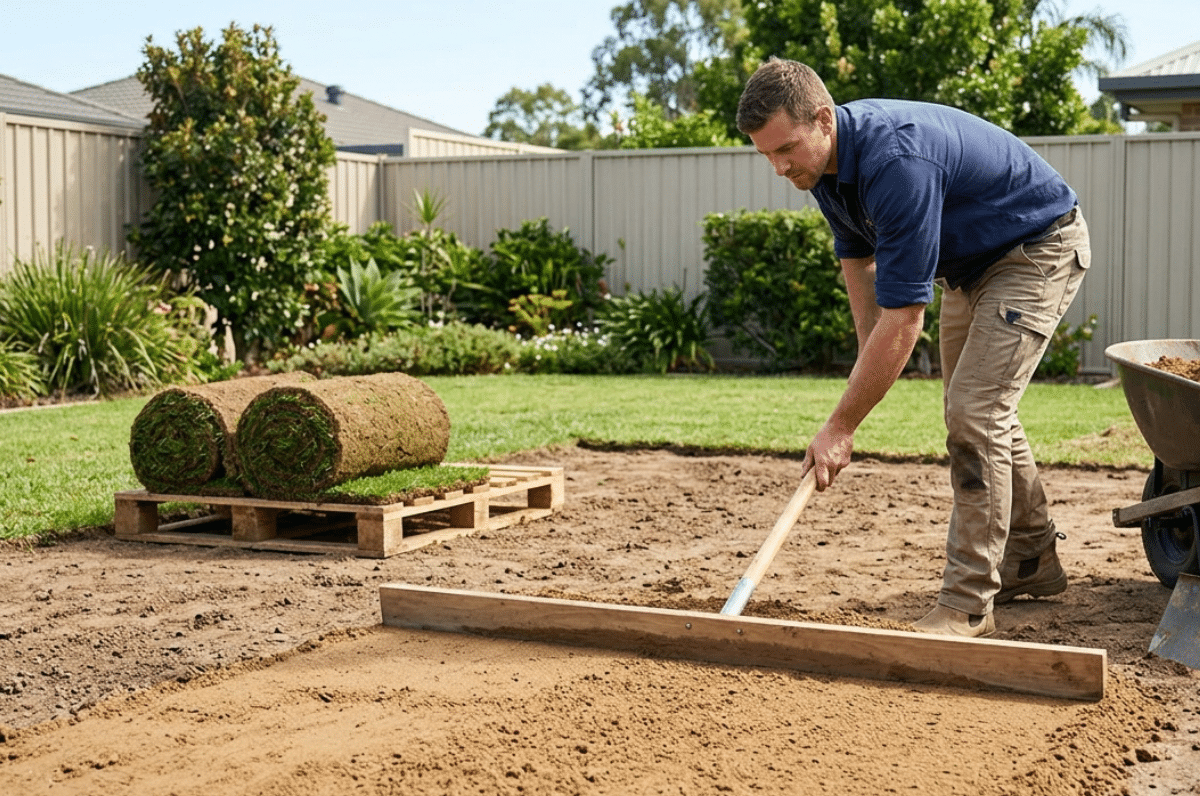
- Top up and screed. Fill the low spots, then screed the surface using a straight length of timber or aluminium dragged across the area. Keep checking your falls with a string line and level.
- Second compaction. Roll again, lightly. You want the base firm enough to walk on without leaving deep footprints, but not so compacted that roots cannot penetrate.
- Final rake. Finish with a light rake to leave a fine, even surface with no clods.
A useful test: walk across the finished base. Your footprints should be visible but shallow, around 5mm deep. Any deeper and it needs more compaction. No print at all and it may be over-compacted.
Set your final level about 20mm to 25mm below the height of paths, driveways and garden edges so the turf finishes flush once laid.
Laying, Rolling and Watering In Your New Turf
Fresh turf is a living product with a short shelf life. Once it is cut and rolled, it starts to heat up on the pallet. In a Queensland summer you have roughly 24 hours to get it down, so book delivery for the morning you plan to lay.
Laying:
- Start along the longest straight edge, such as a fence line, path or driveway.
- Lay rolls tightly butted together with no gaps. Gaps dry out and invite weeds.
- Stagger the joins in a brick pattern rather than lining them up.
- Never stretch the turf to close a gap. It will shrink back and leave a seam.
- Cut edges and curves with a sharp knife or spade, and use offcuts to fill small areas rather than tiny slivers that dry out.
- Avoid walking on freshly laid turf. Work from a board or from the unlaid side.
Rolling: Once it is all down, run a lawn roller over the whole area. This presses the turf into contact with the underlay, which is essential for roots to bridge into the soil.
Watering in: Water immediately and heavily. The first watering needs to soak right through the turf and into the underlay below, around 20mm to 25mm of water. Lift a corner to check the soil underneath is wet, not just damp.
For the first two weeks, water daily in warm weather, ideally early morning. After that, taper back to deeper, less frequent watering to encourage roots to chase moisture downward. Stay off the lawn as much as possible for the first fortnight, and wait until the turf has knitted down before the first mow, usually two to three weeks, taking only the top third off.
Common Turf Prep Mistakes That Cost Locals a Whole Lawn
After four decades in the yard, we see the same handful of mistakes turn into replacement jobs. Here is what to avoid.
- Laying over living grass. The old lawn grows back through and you end up with a patchy mess within a season.
- Not enough underlay. A skim of 20mm is not a root zone. Roots hit compacted clay and stall.
- Using the wrong soil. Heavy garden soil or unscreened fill under turf holds water, settles unevenly and creates dips.
- Ignoring drainage. If it puddled before, it will puddle after, only now with expensive turf on top.
- Ordering turf too early. Turf sitting on a pallet in the sun for two days is already stressed before it hits the ground.
- Skipping compaction. You will see the settlement as a series of soft hollows about a month in.
- Under-watering in week one. Light daily sprinkles wet the turf but not the soil beneath, so roots never bridge down.
- Mowing too soon or too low. Scalping new turf before it has rooted sets it back badly.
- Wrong turf for the spot. A sun-loving couch under a shady tree will thin out no matter how good the prep was.
Almost every one of these is cheaper to avoid than to fix. If you are unsure at any stage, ring us before the truck rolls out rather than after.
Turf Supplies Caboolture: Pickup, Trailer Loads and Free Local Delivery
Landscape City is set up to make the whole job easy, whether you are grabbing a couple of trailer loads or organising a full delivery for a landscaping project.
What we supply for turf jobs:
- Fresh turf suited to South East Queensland conditions
- Turf underlay and screened topsoil
- Sands for levelling and topdressing
- Drainage gravel, crusher dust and road base
- Soil conditioners and bulk fill
- Cement, pavers and blocks for edging and garden borders
How to get it:
- Pickup. Bring your ute or trailer to our yard at 32-36 Wildlily Rd, Caboolture. We load anything from a shovel full to a full load, so you only pay for what you need.
- Delivery. We deliver across Caboolture, Morayfield, Burpengary, Narangba, Elimbah, Beerburrum, Woodford, Bribie and Deception Bay. Free delivery applies on 10m³ loads to the Caboolture area, and we offer mates rates on 10m³ loads.
We are open Monday to Friday 6am to 5pm and Saturday 7am to 3pm, so you can load up early before a weekend job and still get the turf down the same day. A temporary 5% fuel levy currently applies to all sales and is reviewed regularly.
Getting your turf job right
Laying turf is not complicated, but it is unforgiving of shortcuts. Kill off the old lawn properly, sort your drainage and falls, use a genuine turf underlay at 50mm to 100mm, compact and screed to a true level, then lay, roll and water in heavily. Get those steps right and your lawn will establish quickly and hold up through both the wet and the dry.
If you would rather not guess at quantities or turf varieties, that is exactly what our team is here for. Give Nick and the crew a call on 07 5499 0299, or drop into the yard at 32-36 Wildlily Rd, Caboolture, and we will help you work out exactly what you need for your block, no waste and no second trips.

Leave a Comments